Quick answer
Why do my gutters overflow in heavy rain when there are no leaves in them?
Gutters overflow without visible leaves because the real blockage sits below your line of sight or inside the pipework. The most common causes are a compacted mat of roof moss and silt lying flat along the floor of the gutter, granular grit shed by ageing concrete roof tiles, a jam in the swan-neck bend at the top of the downpipe, sludge trapped underneath gutter guards, or a silted-up gully at ground level backing water up the system. None of these are visible from the ground, they only show on a camera inspection or once the trough is vacuumed out.
You are not imagining it, and your gutters are not “clean”
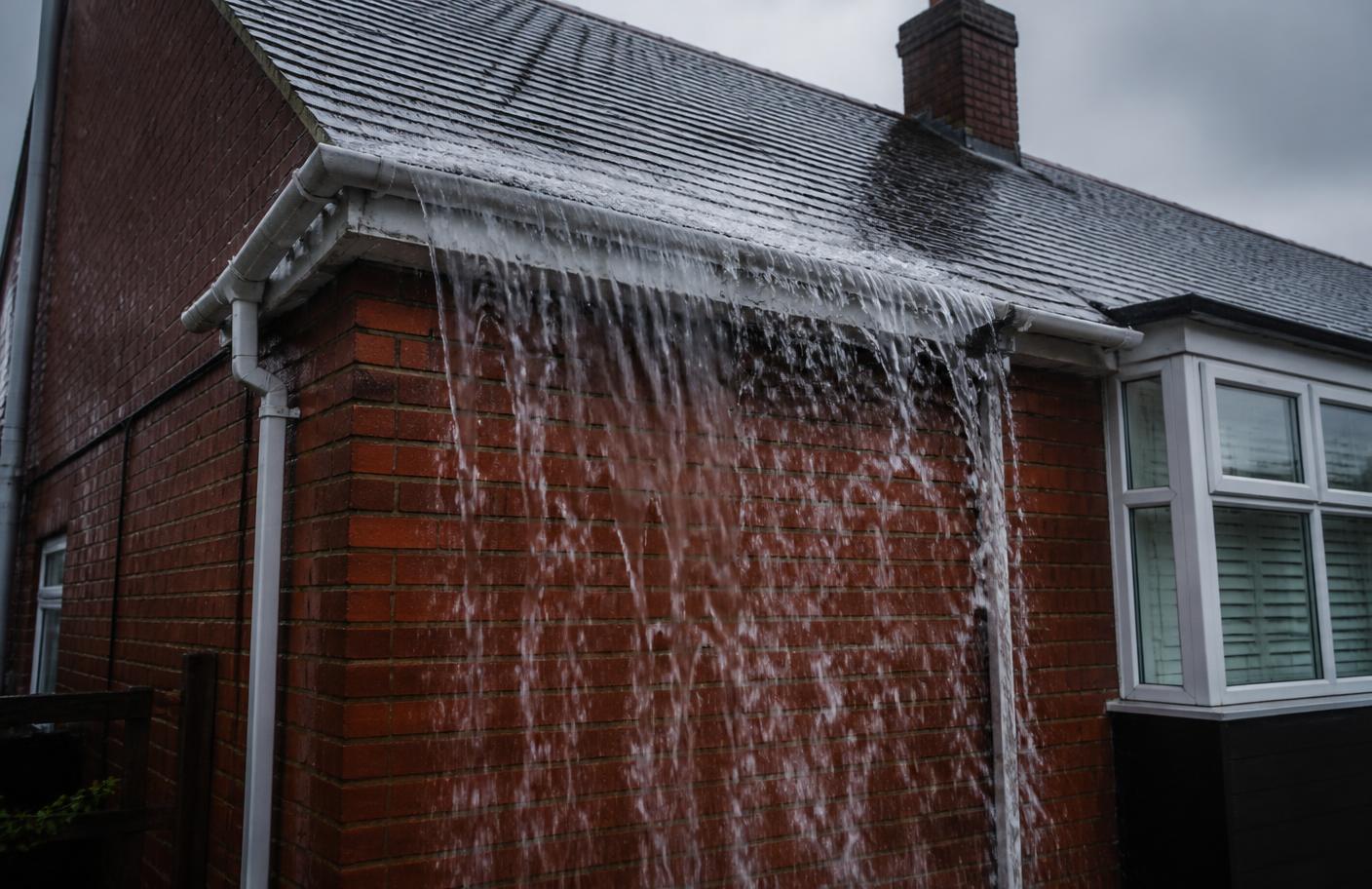
It is one of the most frustrating things a homeowner deals with. A storm rolls through, you look out of the window, and there is a waterfall pouring off the front of the house. You go outside afterwards, crane your neck, and see nothing. No leaves. No twigs. No obvious mess. So why is the water not going where it should?
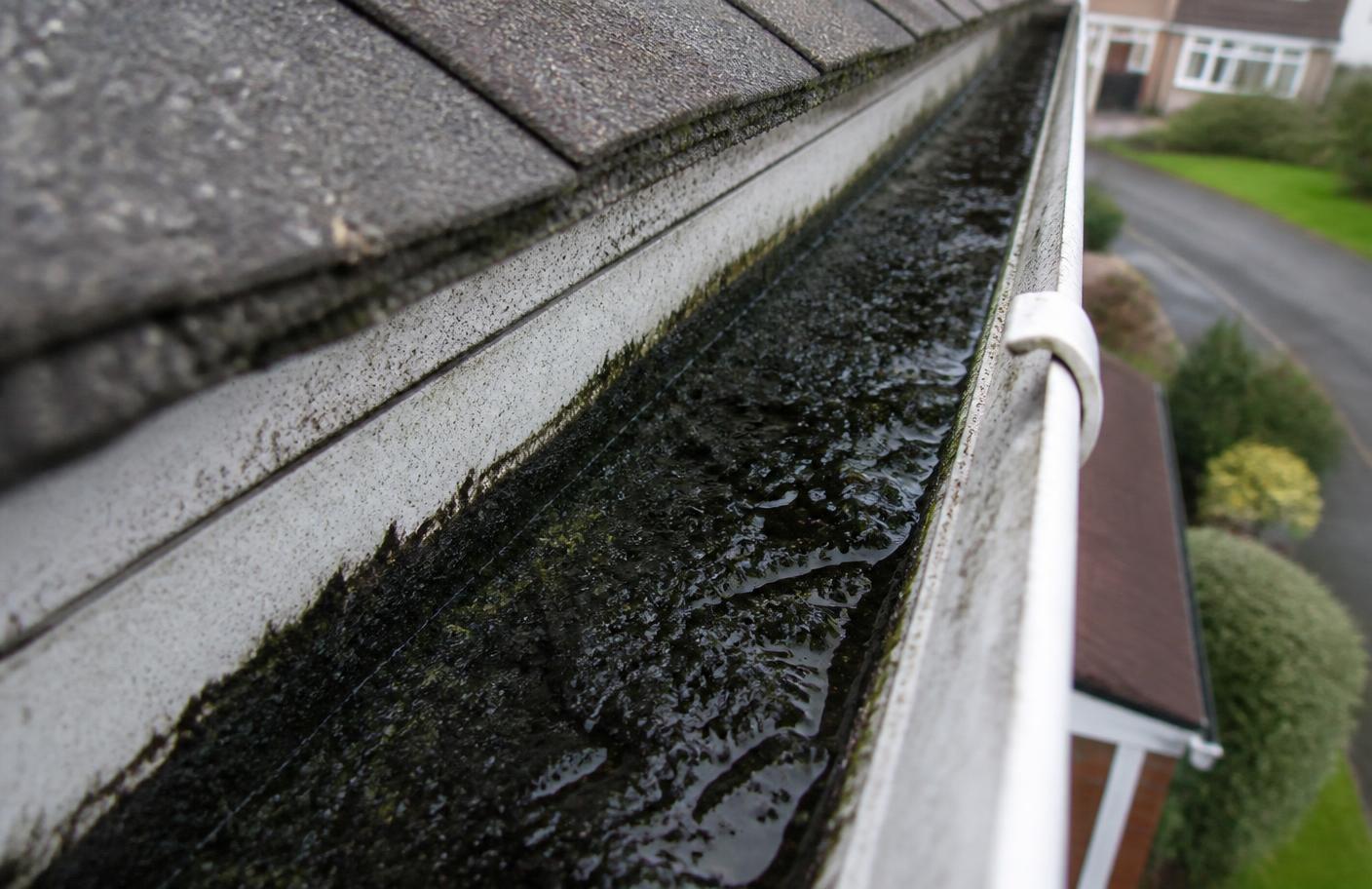
Because “no leaves” does not mean “no blockage”. Leaves are simply the only debris large enough to break the silhouette of the gutter when you look up at it. Everything else that blocks a British gutter, moss, silt, roof grit, decomposed matter, bituminous granules, lies flat. It sits on the floor of the trough, at most a couple of centimetres deep, completely hidden behind the front lip.
A gutter only needs to lose a small fraction of its cross-section to fail in heavy rain. Under a downpour, a standard roof pitch delivers water into the trough far faster than most people imagine. Reduce the flow path by even 15–20mm of sludge and the trough fills faster than it can drain, and the surplus goes over the front edge, which is exactly what you are watching.
The line-of-sight illusion
Standing on your driveway, you can only see the top edge of the gutter. Everything that actually causes overflow lives below that line.
| What you can see from the ground | What is actually in the trough |
|---|---|
| Nothing, the gutter looks empty | A flat 15–30mm mat of compacted moss and silt |
| Clean white uPVC front face | Granular roof-tile grit forming a dam at the outlet |
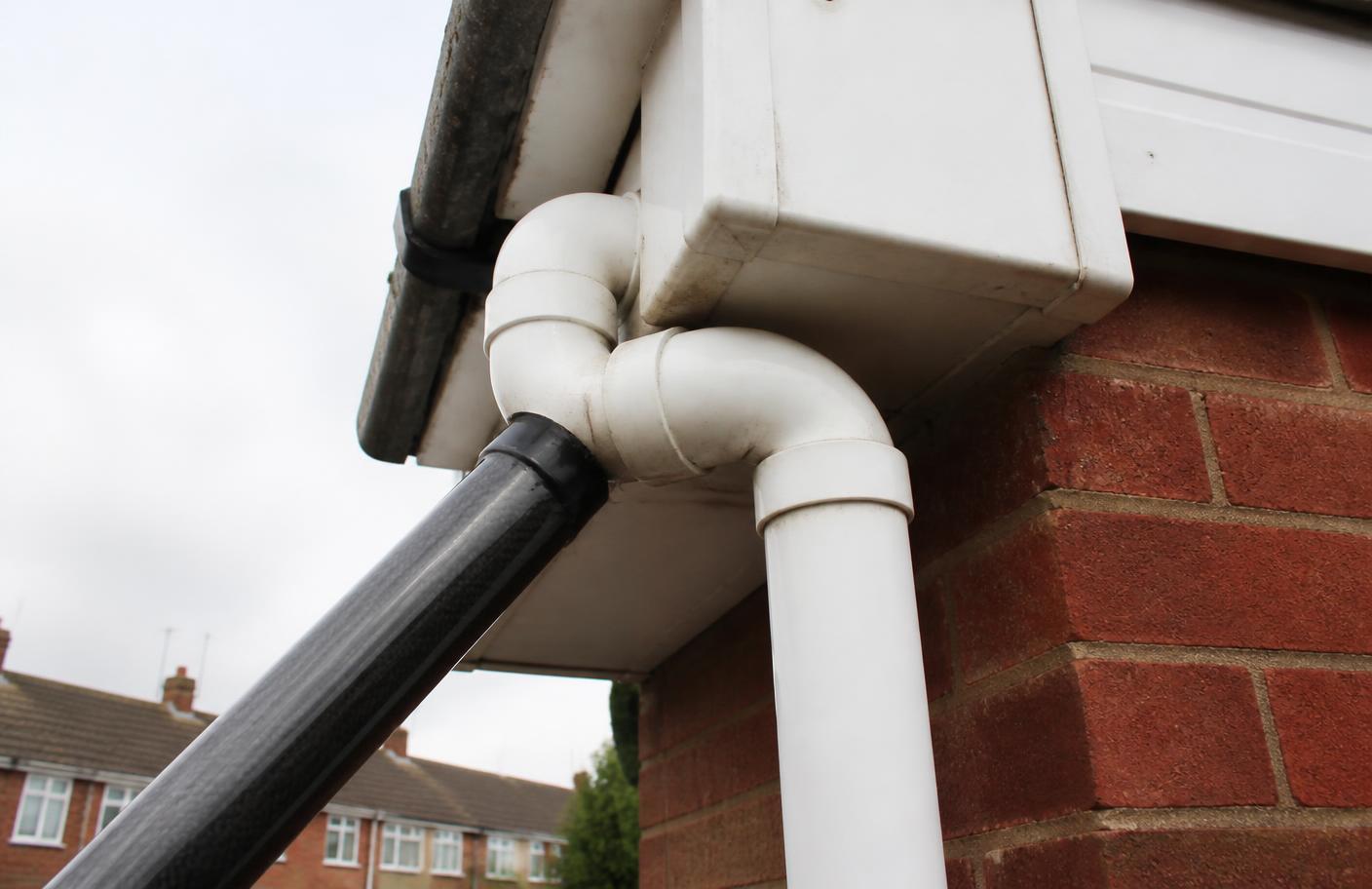
| A downpipe with no visible damage | A solid plug wedged in the swan-neck bend behind the fascia |
| A tidy gutter guard or hedgehog brush | Rotting sludge trapped underneath the bristles |
| A gully with a grid over it | A silted trap that backs water up the pipe in a downpour |
Nothing, the gutter looks empty
- What is actually in the trough
- A flat 15–30mm mat of compacted moss and silt
Clean white uPVC front face
- What is actually in the trough
- Granular roof-tile grit forming a dam at the outlet
A downpipe with no visible damage
- What is actually in the trough
- A solid plug wedged in the swan-neck bend behind the fascia
A tidy gutter guard or hedgehog brush
- What is actually in the trough
- Rotting sludge trapped underneath the bristles
A gully with a grid over it
- What is actually in the trough
- A silted trap that backs water up the pipe in a downpour
This is why a camera inspection changes the conversation. Until the trough floor is on a screen in front of you, everybody is guessing.
What overflow actually looks like when it happens
The five hidden blockages behind “no leaves” overflow
In Coventry and Warwickshire these five account for almost every no-visible-leaves overflow we are called out to.
1. Compacted moss sludge
The single most common cause. Moss growing on concrete roof tiles sheds constantly, washes into the gutter, decomposes and compacts into a dense black mat. It holds water like a sponge, sets like clay in dry spells, and lies completely flat, invisible from below.
2. Roof-tile grit and mineral granules
Ageing concrete tiles and felted flat roofs shed a fine sand-like grit. It travels with the rainwater and settles at the lowest point of the run, nearly always right at the downpipe outlet, where it forms a dam that only shows itself under real flow.
3. A jammed swan-neck at the top of the downpipe
The offset bend that carries the downpipe back to the wall is the tightest point in the whole rainwater system. A wad of moss, a bird's nest fragment or a tennis-ball-sized clump of silt lodges there and the trough simply cannot empty, no matter how clean it looks.
4. Silt trapped under gutter guards
Hedgehog brushes and mesh guards stop leaves, which is exactly why owners assume they never need cleaning. Fine silt and moss pass straight through, rot underneath, and the guard then traps that sludge in place, making both the overflow and the eventual clearance worse.
5. Nesting and pest debris
Starlings, pigeons and squirrels drop nesting material into troughs and behind fascia boards. A partial nest sits low in the run, soaks up water and blocks the flow toward the outlet without ever breaking your line of sight.
A three-step diagnostic you can do from the ground
You do not need a ladder to narrow this down. Do these three checks in the next heavy shower and you will know a great deal more than you do now.
- 1
Watch where it spills
Overflow at one fixed point every time means a blockage or a dropped bracket at that spot. Overflow along a whole run means the trough is loaded end to end. Overflow directly above the downpipe points at the outlet or the swan-neck.
- 2
Tap the downpipe
Knock the pipe with your knuckles from top to bottom. A hollow, resonant note means it is clear. A dull, dead thud at one height tells you exactly where the plug is sitting.
- 3
Check the gully at the bottom
In heavy rain, look at the gully or drain the downpipe discharges into. If water is pooling around the grid rather than disappearing, the underground trap is silted and the whole system is backing up from below.
Any one of those three results tells us where to point the camera first, and shortens the job on the day.
Why local housing stock makes this worse
Coventry and Warwickshire have a specific combination of factors that produce hidden gutter blockages faster than the national average: a large stock of interwar and post-war housing with ageing concrete roof tiles, a damp temperate climate that keeps moss growing all year, and a huge amount of mature tree canopy on the older residential roads.
The tiles are the key part. Concrete tile from the 1930s to the 1970s is porous, and porous tile grows moss. Every rainfall carries some of that growth into the gutter, along with the grit the tile surface is slowly losing. That is a continuous, year-round supply of the exact material that lies flat and blocks silently, quite unlike autumn leaf fall, which is seasonal and obvious.
Where we see it most
Architecture matters more than postcode. These are the local patterns behind the majority of no-visible-leaves overflow calls.
Coventry suburbs (CV3, CV5, CV6)
1930s bay-fronted semis with original concrete tile, Earlsdon, Cheylesmore, Finham, Styvechale
£80, £130
Heavy tile moss plus mature street trees. Overflow here is nearly always sludge, not leaves.
Learn moreNuneaton & Bedworth (CV10–CV12)
Post-war estate semis and extended former cottages
£75, £120
Long shallow runs with a single downpipe, swan-neck jams are disproportionately common.
Learn moreLeamington, Warwick & Kenilworth (CV8, CV31–CV34)
Regency and Victorian townhouses, cast iron guttering, three-storey elevations
£95, £180
Deep cast-iron profiles hold far more silt before they visibly fill, so overflow arrives suddenly.
Learn moreWhat it costs if you leave it overflowing
Overflow is not a nuisance, it is a water-ingress problem. Every downpour puts concentrated water onto one part of your wall.
| What eventually fails | Typical repair cost | How long it usually takes to appear |
|---|---|---|
| Professional clean and downpipe flush (prevents all of the below) | £80, £160 | Annual maintenance |
| Fascia and soffit rot | £600, £1,500 | 12 to 18 months of overflow |
| Penetrating damp and internal mould | £1,000, £3,500 | 24+ months |
| Mortar erosion and brick spalling (repointing) | £800, £2,000 | 30+ months |
| Soakaway, gully or ground-level failure | £2,500+ | 36+ months |
Professional clean and downpipe flush (prevents all of the below)
- Typical repair cost
- £80, £160
- How long it usually takes to appear
- Annual maintenance
Fascia and soffit rot
- Typical repair cost
- £600, £1,500
- How long it usually takes to appear
- 12 to 18 months of overflow
Penetrating damp and internal mould
- Typical repair cost
- £1,000, £3,500
- How long it usually takes to appear
- 24+ months
Mortar erosion and brick spalling (repointing)
- Typical repair cost
- £800, £2,000
- How long it usually takes to appear
- 30+ months
Soakaway, gully or ground-level failure
- Typical repair cost
- £2,500+
- How long it usually takes to appear
- 36+ months
More detail on how the water gets into the wall: blocked gutters and damp damage.
Want to know what is actually in your gutters?
We put an HD pole camera along every run and show you the footage before anything is quoted, including the downpipes.
Why a ladder clean often fails to fix this
Hidden blockages are exactly the kind a traditional scoop-from-a-ladder clean misses, and exactly the kind a camera finds.
Ladder scooping
Blind, partial, unverifiable
- Only the sections a ladder can safely reach get touched
- Compacted sludge is scraped, not removed, a film is always left behind
- Downpipes and swan-necks are almost never opened or flow-tested
- No footage, so you cannot tell what was cleared from what was skipped
- Ladder feet and rungs damage aged uPVC, brackets and tile edges
Ground vacuum + camera
Complete, sealed, evidenced
- Every run reached from the ground, including over conservatories and extensions
- High-suction extraction lifts compacted moss mats, not just loose debris
- Downpipes cleared and flow-tested through to the gully
- Before-and-after HD footage of each run handed to you
- Nothing rests on your guttering and nothing lands on your driveway
How we actually clear it
A carbon-fibre pole carries the vacuum nozzle up to the trough while the operator stays on the ground, fully compliant with the Work at Height Regulations 2005. The camera goes up first so you can see the blockage for yourself, then the extraction runs the full length of the gutter and everything ends up sealed in a steel drum rather than on your patio.
Downpipes are then cleared and flushed to ground level, and the gully is checked. Finally the camera goes back along each run so you have proof the trough is bare, not just a promise. If we find a dropped bracket, a failed joint or an incorrect fall while we are up there, we photograph it and tell you, cleaning gets quoted first, repairs only where they are genuinely needed.
If you want to know what the job is likely to cost before you call anyone, our full local price breakdown is here: gutter cleaning cost for a 3-bed semi.
Estimate your price range
Pick your property type and tick anything that applies. Same flat per-run pricing we quote on the doorstep.
1 · Property type
2 · Anything else apply?
Estimated price, inc VAT
£80 , £160
Based on approximately 3 gutter runs at £40 per run. Downpipe checks and camera proof are included.